

Table of Contents
Net-zero ready home is no longer just an eco catchphrase—it’s a must-know cost topic if you want to avoid costly retrofit surprises and maximize energy savings from day one. In 2024, building a net-zero ready home costs only about 5% to 8% more than a standard new house, but what you get in long-term savings, comfort, and hassle-free upgrades makes that small premium pay off—if you do it smart, at the right stage. Not all energy upgrades are equal, and construction-stage decisions shape your future energy bills, payback timeline, and how much you’ll regret skipping “invisible” details. This guide breaks down the actual math, region by region, and tells you exactly where your real leverage—and savings—hide.
Key Takeaways
- The net-zero ready home premium is about $10,000 to $14,000 after incentives in 2024—worth it for long-term energy savings and lower retrofit headaches.
- Failing to plan for future upgrades (like smart wiring paths and moisture control) can cost $2,000 to $4,000+ to fix later, versus $200–$400 during initial construction.
- Region and timing matter: Get every rebate you can, benchmark your local per-square-foot cost, and follow a checklist to avoid costly omissions or regrets.
- Quick answer — Is a net-zero ready home worth the premium?
- 2024 cost comparison by region — net-zero ready construction cost per sq ft
- Typical energy-efficient upgrade costs (incremental, not whole-house)
- How incentives move the needle — credits, rebates and realistic ROI timing
- The most common homeowner regrets after finishing a net-zero-ready home (and exact retrofit cost traps)
- Three high-value, under-covered strategies competitors rarely explain (and exactly what to specify)
- How to specify future-proof conduit, wiring and mechanical room layout (checklist for plans/specs)
- Moisture management for high-R envelopes — what to specify and why it matters
- Passive ventilation and natural cooling — detailed design tactics often skipped
- Quality control: tests and inspections to demand during construction
- A simple budget worksheet and decision flow for buyers: retrofit vs build-net-zero-ready
- Short FAQs and closing CTA for readers (what to ask your builder/architect)
Quick answer — Is a net-zero ready home worth the premium?
If you’re weighing a net-zero ready home against incremental energy upgrades, here’s the math: in 2024, a fully net-zero ready package averages about 5%–8% premium over a standard new build. Before incentives, that’s around $51,000 in extra construction costs, but after robust federal and often local/state rebates, the typical homeowner ends up spending just $10,000 to $14,000 more. That gets you a home built from day one for ultra-low bills, comfort, and “solar ready” performance, without the delays or payback risks that patchwork upgrades bring. If you skip the up-front investment, you might face higher bills, clunky retrofits, and missed incentives.
Action Step: Before breaking ground, verify actual rebates in your region and do a whole-project cost comparison—not just individual upgrades.
2024 cost comparison by region — net-zero ready construction cost per sq ft
Net-zero ready home cost varies widely by location, but average ranges are now well documented. Here’s what real builders are seeing in 2024:
- Pacific Northwest: $291–$425 per square foot
- Northeast (e.g., MA, NY): $350–$500 per square foot
- Southeast: $250–$350 per square foot
- Midwest: $260–$380 per square foot
- Southwest: $300–$420 per square foot
Most of the premium comes from upgrading the shell, mechanical, and controls, not the finishes. These ranges do not include the additional costs for custom architecture or luxury finishes.
See regionally detailed figures and sample calculations here.
Action Step: Price your plans using local builders’ real-world numbers and compare to the above. Plug in incentive effects before making a buy/no-buy call.
Typical energy-efficient upgrade costs (incremental, not whole-house)
What if you only want to “bolt on” the most common energy efficient home upgrades to a standard new house? Here’s what you’ll typically pay in 2024:
- Shell upgrades (insulation, advanced framing, airtight doors, high-performance windows): $7,000–$12,000
- HVAC upgrades (better heating/cooling, ERV, electrical, some plumbing): $3,000–$4,000
- Solar PV and hot water: $36,000–$40,000
Mix-and-match upgrades may seem cheaper, but often bring long paybacks and tricky integration later. For many buyers, the cost of missing out on rebates and having to retrofit is much higher.
See more on energy saving house tips and specifics for your climate zone.
Action Step: List your likely upgrades, total the costs, then compare package deals with net-zero ready whole-home builds—don’t forget hidden labor and staging costs for retrofits.
How incentives move the needle — credits, rebates and realistic ROI timing
Federal and state incentives can drop your out-of-pocket net zero house cost by 60–80% in some regions. As of 2024:
- Federal tax credits: Energy Efficient Home Improvement Credit covers items like doors, windows, insulation, and select HVAC from $250–$1,200 each; air-source heat pumps up to $2,000; $150 for home energy audits; see details here. Credits are available through 2032.
- Typical net effect: Up-front net-zero ready premium drops from average $51,000 to $10,000–$14,000 (source).
- ROI timing: Most buyers see true payback in 7–12 years, but faster in high-utility-cost areas or with maxed-out rebates.
Action Step: Use tools like the Department of Energy’s Energy Saver and your state’s energy office to stack local/utility rebates on top of federal credits before making project decisions.
The most common homeowner regrets after finishing a net-zero-ready home (and exact retrofit cost traps)
Owners who have built or bought a net-zero ready home share hard-won lessons—some minor, others financially painful. Here are the most common pitfalls and their real cost impacts:
| Skipped or Underspecified Item | Cost to Fix Later | Cost if Done Upfront | Why It Matters |
|---|---|---|---|
| Conduit/network/low-voltage paths | $2,000–$4,000+ | $200–$400 | Running wiring for future solar, EV, or network gear is 10x costlier after walls go up. |
| Roof or basement insulation improvements | $35,000–$80,000 (lost performance/payback stuck) | Small premium (included in net-zero package) | Skipping high-R insulation creates future comfort/energy and resale headaches. |
| Poor mechanical room planning | $2,000–$4,000+ (moving heat-producing gear) | Zero or minimal added cost | Avoid overheating living spaces and simplify monitoring/controls by planning locations and paths upfront. |
| Omitted smart panel prep | $2,000+ (drywall, chase, upgrade labor) | $150–$300 | Adding a whole-home monitor becomes a major hassle if no panel rough-in or extra slot exists. |
Beyond cost, regrets include: excess equipment heat in hallways, limited design/fenestration options, long or uncertain paybacks, and post-construction complexity integrating monitoring—most of which are fully avoidable with checklists and surplus rough-in now.

Action Step: Before you sign off on plans, ask for a “future upgrades” map—specifying every chase, conduit, and mechanical equipment layout, and request detail on roof/basement insulation by R-value and assembly, not just brand.
Three high-value, under-covered strategies competitors rarely explain (and exactly what to specify)
Most guides skip three details that consistently separate regret-free energy efficient homes from those that cost more than they should.
- Future-proof conduit and low-voltage routing: Install spare conduit and chases from mechanical rooms to key locations (garage, roof, attic, main panel, low-voltage zones) for solar, EVs, or network. This costs $200–$400 at build stage, but $2,000–$4,000+ if retrofitted, plus wall repair and envelope breach risk. future-proof conduit. Learn how to plan conduit for net-zero homes.
- Advanced moisture management: Specify vapor-permeable or mat-faced foam, continuous drainage planes, and rainscreens on any high-R wall. Avoid using traditional sheathing alone, which can trap moisture and signals.
- Sophisticated passive ventilation: Use automated window operators, stack-effect vent sizing (north-south cross-vent paths), and integrated indoor-outdoor sensors to allow for natural cooling during swing seasons, while keeping airtightness tested and intact.
Action Step: Direct your builder or architect to include those three features in THEIR checklist and check that they appear on both drawings and contracts.
How to specify future-proof conduit, wiring and mechanical room layout (checklist for plans/specs)
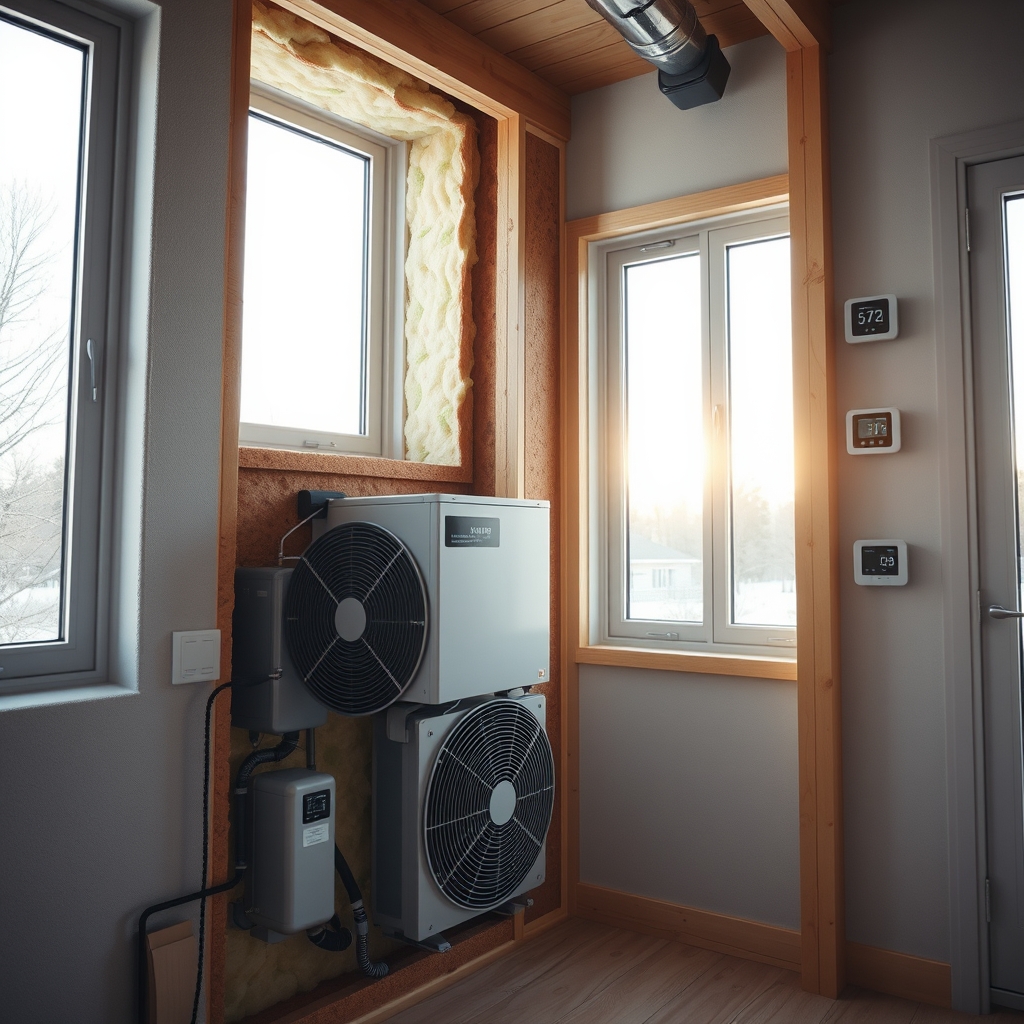
Checklist for future-proof specs:
- Label and specify 1.5-2 inch conduit paths in all plans (include spares near electrical panels, attic, and mechanical spaces).
- Locate all heat-producing gear (servers, inverters, heat pump water heater) in the same isolated room—consider exhaust ducting or passive cooling here.
- Designate panel locations for smart electrical monitoring and ensure an extra hub for low-voltage/smart home gear.
- Include access panels and leave inspection cameras on site until insulation and drywall are verified.
Action Step: Demand a signed-off, labeled “future upgrades” plan before payment for framing—make it part of your build contract.
Moisture management for high-R envelopes — what to specify and why it matters
Poor or missing moisture management can quietly kill your energy efficient home upgrade ROI. For every high-R wall, specify:
- Vapor-permeable weather barriers (not just vapor retarders) for most climates,
- Mat-faced foam or mineral wool on the exterior side,
- rainscreen furring to allow drainage and drying,
- Continuous drainage plane behind cladding,
- Moisture meter “inserts” in trouble-prone corners for future inspection.
Testing should include: blower door at sheathing stage, thermal camera scan before insulation, and post-insulation verification.
See real-world case studies of envelope testing.
Action Step: Demand these assemblies and inspections in your specs—don’t leave it up to “builder standard practice.”
Passive ventilation and natural cooling — detailed design tactics often skipped
To genuinely save energy (not just brag about air tightness), include these passive home design features:
- Design cross-ventilation using openable windows on opposite elevations and stack effect from first to top floor,
- Specify automated window operators or sensor-triggered roof windows/skylights,
- Integrate indoor and outdoor temp/humidity sensors tied to your smart home hub,
- Set blower-door testing/air sealing goals but allow for “ventilation windows” that unlock only when sensors call for natural cooling.
Learn more about sizing passive ventilation for your project.
Action Step: Ask your architect to deliver a “stack effect vent map” showing all airflow pathways, actuator wiring, and sensor locations—include cost allowance upfront.
Quality control: tests and inspections to demand during construction
Testing at multiple build stages isn’t just about compliance—it’s how you avoid hidden leaks and insulation gaps that break the net zero house cost model. Require the following:
- Blower-door test after main sheathing and after insulation (target <0.6 ACH50),
- Thermal camera inspection after insulation install, before drywall,
- Duct leakage/ERV system test before finish,
- Final commissioning (system balances and equipment run-in) with utility bills confirmed for baseline.
Example: Re-testing after sealing found and fixed leaks that would have cost thousands in comfort and lost rebates (source).
Action Step: Write specific targets and test dates into your contract—payment should be conditional on passing them.
A simple budget worksheet and decision flow for buyers: retrofit vs build-net-zero-ready
There’s no magic bullet—only clear math. Here’s a simple step-by-step:
- Estimate your local per-square-foot cost:
Pacific Northwest: $291–$425/ft²; Northeast: $350–$500/ft²; Southeast: $250–$350/ft²; Midwest: $260–$380/ft²; Southwest: $300–$420/ft². - Add a net-zero ready premium: 5%–8% (about $10,000–$14,000 after rebates and tax credits).
- Compare to typical upgrades: Envelope ($7,000–$12,000), HVAC ($3,000–$4,000), Solar PV/hot water ($36,000–$40,000).
- Subtract incentives: Apply local, utility, and federal credits from your total (see section above),
- Flag the three omission traps: If you’re >$2,000 short on conduit, miss mechanical room planning, or skip moisture assemblies, strongly consider building net-zero ready whole-house. Retrofitting these is budget-busting later.
For a fillable worksheet, see our Net Zero House Cost Calculator.
Action Step: Run the numbers yourself, then bring your own worksheet and tough questions to your architect or builder’s initial meeting.
Short FAQs and closing CTA for readers (what to ask your builder/architect)
Bring these practical, money-first questions to your first builder or architect meeting for your net-zero ready home:
Should I install conduit everywhere now, even if I don’t plan solar or EV soon?
Yes, because the cost difference is massive: $200–$400 during construction vs $2,000–$4,000 or more retroactively, plus wall repair and energy loss risk.
What exact insulation assemblies will you build for the roof and basement?
Demand R-values and specify each material; these are your first defense against energy loss and payback drag.
How will you manage moisture in high-R walls?
Ask for vapor-permeable or mat-faced exterior insulation, drainage planes, and visible rainscreen details—a builder’s willingness to specify this reveals their experience.
What ventilation strategies do you design for swing seasons and natural cooling?
Make sure there’s a passive, stack-effect plan that leverages sensors or automated windows if possible.
Will you help document and claim every rebate or incentive I’m eligible for?
Some builders won’t, but you should push for up-front clarity and, if possible, contract for this support.
What testing/inspection steps do you require, and what is the pass threshold?
Minimum: blower door testing before and after insulation, with clear ACH50 goal (<0.6 for net-zero ready); don’t pay until this is documented.
Bottom line: The most common regret is missing cheap, high-value “future proofing” during construction—keep the focus on checklists, conduit, and insulation detail. For more detailed checklists and sample contracts, visit our post on energy efficient home upgrade.
The path to a successful net-zero ready home is less about technology, more about specifying invisible but essential details—and demanding them in writing. Start early and keep asking the unpopular, practical questions.
—